 Play Theme
Vitals:
Age: 25
Hair: Black
Eyes: Brown
Complexion: Reddish-brown
Height: 5'4"
Weight: 118 lbs
Weapon of Choice: Takkar Pistols
Appearance:
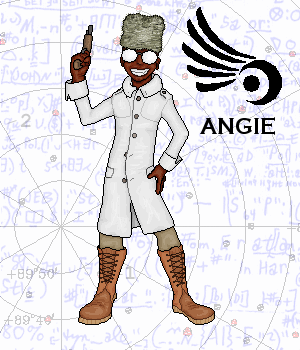
Angie is short and thin, but often bundles herself up heavily, giving her the illusion of size. Her skin is dark mahogany and is callused and scarred around the hands, feet, arms and legs thanks to years of careless roaming. She has childlike facial features and wide, bright eyes hidden behind the thick, round lenses of a pair of glasses. She keeps her hair very short, cut almost to the scalp when she's able to get a good cut. As a child, she kept her hair shoulder-length, but early on in the Maria expedition she shaved her head in a fit of pique, and came to like the very short hair that came in after a couple weeks. She gets cold very easily and likes to bundle up: when on the road, she wears a round, grey fur hat and a high-collared white coat that descends to her knees. She wears a pair of brown steel-toed boots that rise nearly to the bottom of the coat. Indoors, she wears slacks and a black sweater overtop a sleeveless shirt. Given her slight build and the amount of stuff on her person, she can pass for a baby-faced boy. She wears a gold earring in her left ear and has a simple wing design tattooed in black on the shoulder of her right arm, both things mementos of the sea voyage.
Although she dresses pragmatically, Angie has a twisted sense of style and will spend quite a while tweaking her outfit for the proper aesthetic effect once it meets her basic needs. In addition to her outfit and her sidearm, Angie carries a large case full of navigational and measuring tools: a sextant, a small telescope, a compass, calipers, a slide rule, and so on. She keeps a harmonica in her coat, which she can play passably, and she always has a second pair of glasses around, since she is very nearsighted without them. When on the road, she has a suitcase full of books and maps. Most of her books are purely practical -- engineering and measurement formulae, logarithmic and trigonometric tables, almanacs of astronomical data, and so on -- but she always has at least one storybook, usually something grand and adventurous.
Personality:
In her early years, Angie was hopelessly distracted, prone to focus for long periods on strange things and then suddenly switch. To her, she was simply following natural logical patterns between seemingly unconnected lines of thought, but to others she just seemed to have a tilted brain. She also tended to be arrogant about her own abilities, and had a petulant dislike of tasks that didn't excite her. Age has tempered these traits, so although she is still somewhat distracted childlike in her approach to things, she can now function bettwe in a structured environment. She has a deep love of patterns, logic, and puzzles, and has a scientist or priest's unshakable faith in the overarching order of the universe. Artificial human-imposed patterns, like social hierarchies and bureaucracies, annoy her with their imperfections, and she is always searching for a way to conform these human social patterns to the grand universal order she intuitively "knows" exists. Astronomy and math are her way of getting in touch with this universal whole -- the more pieces of the grand machine she understands, the closer she is to perceiving its nature. Finding someone else who shares her interests always fills her with a giddy joy, but nonetheless she is always a little uncomfortable around other clever people, feeling that she has to compete with them.
Angela is neither squeamish nor prudish. She grew up surrounded by vats of rotting flesh and spent three years on a ship. However, she has a broad romantic stripe; though intimately familiar with the unattractiveness of life and the many weaknesses in human nature, she thinks in terms of noble ideals and grand themes. She hates history, but adores legends, whether true or not, feeling that stories of heroes and explorers represent a noble ideal that people can become better by emulating. Stories are also entertaining, and Angie puts high value on fun.
Angie tends to babble and often jumps from one train of thought to another without explanation, but people who can get past these tendencies find her a pleasant social partner. Some of her tastes are pretty strange, but she also enjoys good friends, good conversation, and good beer, the same as everyone else, and her excitement can be contagious. As long as she doesn't feel intellectually threatened and isn't fixating on something arcane, she's entirely pleasant to be around.
Angie's mind often focuses on abstract and arcane topics, but within that sphere it is sharp as a razor. She can perform calculations with blinding speed and is very good with math, geometry, and puzzles. Most of this knowledge has no practical day-to-day use, but with her instruments and tables in hand she is an expert navigator and orienteer and, given the time and tools to take proper measurements, can create very accurate maps -- both useful skills in an age of exploration.
Although Angie appreciates the many joys of day-to-day life -- carousing, chatting, playing games, singing songs -- she has a lot of trouble dealing with everyday woes. Her personal belief is that the many unhappinesses of daily life -- hate, deceit, illness, war -- come from imperfections in the system by which people live their lives. However, she is keenly aware that these problems cannot be easily solved. In the long term, she thinks that exploration, science, and philosophy may win the day, but in the short term these events take their toll on her. Several people close to her have died for no particular reason, and the seeming senselessness of these mundane woes tests her faith and resolve.
Motivations:
Angie holds dear an ideal of noble exploration, and wants to get as close to this as she can. As a child she dreamt of sailing across the ocean to unknown lands, like the characters in the adventure stories her brother told her. On the one hand, this is motivated purely by a desire to get out and see the world, to live life to the fullest. However, she also believes that such exploration can help solve the many mysteries that plague the modern world. Each observation made, each mile charted, is a piece of a grand scientific puzzle. The puzzle hides not only the future of the struggling human race, but the answers to all the mysteries of science. Realistically, she knows that people will never know *everything*, but every little bit helps. Maybe the night sky is a map to a better world.
The world is a scary place. Angie can usually take care of herself, but sometimes things just go wrong. Having taken over her mentor's role, she's keenly aware that what happened to him could happen to her. Since she went out into the wild world, she has been afraid many times, and although she's come out unharmed so far, she knows that it may just be a matter of time. She likes to take her time to analyze problems; the abject horror of total helplessness can paralyze her, affecting her ability to make quick decisions in a crisis. As long as she expects trouble or thinks she has a fighting chance, she's fine, but when confronted with an unexpected scare or a seemingly insurmountable peril, it takes all her will not to run or cower. She is aware of all of this, and although she downplays the problem to others for the sake of her image, in secret she wonders if she is cut out for the dangers of the lifestyle she has adopted.
 Background:
On the frontier, everybody grew up fast. By the time she was eight, Angie Baker was at the centre of a whirlwind of nonstop activity. Every day, new houses went up, and the shipyards were well underway, promising sea trade with New Meribia within the next few years. In the meantime, wagons rattled back and forth along the rough trail between the two cities, carrying crafts and meat and tools. Tom had settled into enough of a routine that he felt comfortable dating, and John and Corey were often off on their own escapades, so Angie found herself unwatched for the first time in her life, and used the opportunity to explore the area. At lunch, she would ride a wagon into town and eat within view of the water. Horses and mechanical engines would carry huge trees down through the main streets of the town to the docks, where workmen would strip, cut and treat them. As fast as the lumber pile built up it was pulled down by the builders, who expanded the docks a little bit each day until an impressive wharf jutted out into the harbour. Angie saw it all happen, eating her sandwiches, sitting atop a distant ledge with her legs dangling down. Then she would hop up and catch a wagon heading back to the outskirts, where she would work the leather and tend the yard and sew and study. She inherited something from each of her siblings: like Tom, she had a fierce love of knowledge and an interest in all things, but she was a flighty and whimsical creature, fluctuating between periods of intense study and wild distraction. Like her youngest brother, she had a head crammed full of dreams of adventure from the stories Tom had told her. As Angie watched the shipyards grow over the years, she imagined a day when grand barques with fluttering sails and proud bows would bring humanity to every corner of the new world.
It was clear from an early age that Angie had inherited both the family inquisitiveness and the sharp wits to put it to use. There was too much work to be done and too little money to spare for her to attend school regularly, but whenever she managed to get hold of a schoolbook, she would pore over it. When at the house, she stayed close to Tom, who taught her the basics of tanning and of the many other tasks necessary to keep a household in order. When she was nine years old, he showed her his notebooks, relics from a dead world, with their creased and discoloured pages and messy penciled notes. She was inspired, and decided to keep her own notebook, which she would thenceforth often be seen scribbling in with a tiny stub of a pencil. It was clear to everyone who knew her that she had strong academic potential, but her dedication came from an obsession with facts and stories, not from a work ethic: she had a hard time applying herself to tasks she was uninterested in, which greatly limited her potential.
Corey's early obsession with Leon faded with time, but it led to an interest in guns and self-defense. He and John bought some of the new sidearms being produced and would often practice together, eventually dragging the whole family along. Tom was suspicious of the gadgets because of their tendency to jam or misfire, but he was the odd man out: Angie eventually ended up enjoying the training as well (though she wasn't very good at it without someone stronger to steady her hands), and trips to the shooting range became a regular event for the family. Firearm accidents were not uncommon in New Takkar, and Angie learned a healthy respect for technology from the dire warnings that any child learning to shoot inevitably received.
Tom married when he was twenty-four. The wife, Rilfa Pollen, was a shy, plain beastgirl with a knack for sewing, and in particular for working with leather. They had originally met through that connection, with her working and selling the raw materials the Baker house produced. She was quiet and reclusive by nature, so although she got along well with Tom due to a long period of acclimation, she had difficulty opening up to the rest of the family. By this time, Angie was thirteen and Corey was a strapping young man who had the attention of the local girls despite his low social standing. John had moved out a few years back to live in a tiny, decrepit little apartment nearer the city, where he now worked as a dockhand. Tom had two skilled apprentices, and between them and his new wife, he was very busy. Untethered from social obligations, Angie would rush through her chores each day and stay out until dark. She had a few friends downtown whom she would often play with, and she was becoming interested in boys, though she had a roundabout way of showing it, often pestering or taunting the target of her latest infatuation. Among her peers, she had a well-earned reputation as an eccentric: strange things entertained her, and she would often become rapturously interested in something completely mundane, like an old tool shed or a smooth striated rock. She had boundless reserves of energy and tended to spend long periods of time hunched over her notebook or staring off into the distance, only to suddenly leap up and tear around in a gale of activity. Sometimes it seemed as though her behaviour was controlled by a deep logic, but the fact of the matter was that she just had no control whatsoever over her attention. Her mind was captivated by patterns, shapes, and the elegant simplicity of nature, but she could find these traits in everything around her, and would allow her attention to coast from one object to another, following invisible aesthetic lines. Like John at her age, she had a tendency to fixate intently on one thing for a short while, then switch abruptly. Every fascination, however brief, left a mark on her notebook (a much rattier affair than her brother's, owing to her careless nature). The two things that could hold her attention reliably were the sea and the sky, and she would spend hours focusing on each. The habit of watching the docks continued all throughout her childhood, and once John began to work there she had the privilege of exploring them firsthand, marvelling at the towering ships. She was under strict orders to return home by dark, but if she had the energy she would often stay out in the Baker yard and watch the stars come out, picking out constellations and jotting them down in her book as messy clusters of dots and squiggles that only she and Tom could interpret. Sailing was a popular topic around town, and she had learned the tricks for taking the measure of stars by her hand and the chimes of the clock. This method was so inaccurate as to be almost useless, but it impressed her friends, and it let her imagine herself to be a part of the grand machine that turned the heavens, which pleased her.
It was clear that Angela had a gift. Despite irregular schooling, she performed far above her peers in math and puzzles and at least as well in most other areas, and when she focused on something (a non-trivial requirement) she showed great attention to detail. Tom hoped to get her into higher-level schooling (somewhat vicariously, as he had never had the opportunity), but there was the question of whether she could be made to apply herself in such a structured environment. Even back then, it was well-known that the Hylan Academy was the best school in the new world, but the family didn't have the money to send her anywhere outside Takkar. For her own part, Angie certainly believed she was smarter than anyone else her age, and the prospect of a place full of books and learning was appealing, but she was reluctant to do anything that would separate her from her family. One night, Tom sat her down to talk with her about it. He would never be a wealthy man, but the business was getting along fine. Like most children, Angie had run through a series of "want to bes," but she had no solid career plan. As things stood, it was looking as if she would either continue working for the family forever, or else get some minor job in town as John had. Tom urged her to try for a scholarship. At this point there were only a few, and most were intended for older students, but Angie was already performing beyond her age, so he felt she had a shot at it. Though uncomfortable with the idea of heading off someplace strange and a little afraid of failure despite her confidence in her own ability, Angie decided to take a shot at the next round of scholarships. This was several months away, and she spent much of the intervening time polishing her academic weak points. These tended to be the subjects that interested her least, like economics and history, so the effort grated on her, but people, and especially Tom, her surrogate father, had faith in her ability to succeed, so she was forced to do her best as a point of pride. That year, she outperformed everyone else in New Takkar in her age bracket of the evaluation tests. She did well, but not exceptionally, on the writing portion -- personal expression was always her weakest area -- but all the trivia she had absorbed over the years gave her a good foundation of general knowledge, and she blew through the math and physical sciences section of the test. As the school year approached, the atmosphere in the Baker house was one of giddy excitement mixed with sadness and anxiety. John had left the house years ago, and although Corey was still there and taking an active role in the business, he had a busy social life, and spent all his free time out. Tom was busier than ever with his new wife, and it was widely expected that a child would be coming along within the next year or two, so the Baker family was breaking up at last.
Each fall, a pair of wagons took students to the Academy, and that particular fall, Angela was in one. After the intial culture shock wore off, she acclimated fairly well. The area was gorgeous, and although she missed easy access to the ocean, the area was striped with rivers. The main problem she had was with the structure. Although she had a respect for authority, she chafed at strict rules, and being very young, she found many of the freedoms she had taken for granted stripped away. Living in one of the school's many dormitories with hundreds of other students her age, she was forced to do what everyone else did when everyone else did it. Denied the privilege of wandering all over the place at odd hours, as she had in her hometown, she would meditate self-pityingly on how she was a delicate flower being trampled under the boot of institutionalized conformity. Determined to take advantage of what freedoms the system allowed her, she spent hours in the library, eventually becoming part of a small social group of library-dwellers near her age. Although she got on well enough with these children, she found them a bit unnerving, as they were all at least as intelligent as she was, and an atmosphere of intellectual competition hovered over their meetings. Having mostly associated with the ordinary downtown children of Takkar, Angie was accustomed to having her intellectual superiority acknowledged when dealing with her peers. Suddenly she found herself surrounded by other children with sharp wits and competitive attitudes. This drove her to study so as to impress the others, but it also shattered her self-confidence. In the end, she benefited greatly from this period of uncertainty, but at the time it caused her many difficulties, and combined with all the other woes of boarding school life, contributed to one of the hardest periods in her life.
For her first year, Angie's performance was spotty. She did exceptionally in math and science, but she was taking a wide selection of courses, and she didn't really apply herself to the things she was less interested in, doing what was necessary to pass but not enough to stand out. Toward the end of the year she realized that she was in danger of losing her scholarship, made a mad scramble before finals, and managed to save her grade on most of her courses through good exam performance. Over the break, she mulled over the semester. She had been aware of her attention problem for some time, but since it never caused her any real difficulties, she had always viewed it less as a problem and more as a misunderstood idiosyncrasy. At last she was forced to have a long look at her study habits, When the next school year started, she forced herself to devote a good chunk of her time to every subject. It wore away at her patience and frayed her nerves, but she did extremely well from that point on, and managed to hold up well in the endless subtle competition between gifted students.
Ivan Chase was a professor at the academy. He was a skilled navigator and cartographer who had worked with the DeAlkirks in the past and had travelled much of the explored world mapping coasts, but such trips took years to prepare for, and he spent the intervening time teaching astronomy, surveying, and a bit of math. Angie was in several of his astronomy classes and discovered a deep love for the subject. It was not something she had studied in Takkar, since the proper instruments were expensive, but once she had the chance to learn she was enthralled, Angie was one of the best students in Ivan's astronomy class, and she liked him because he was a pleasant cheerful sort of guy with a great love for his work, and of course he did expeditions to unknown lands, which seemed so wonderful to her. He came to like her as well, since she was a good student, had a strong interest in the subject matter and was always full of energy.
At some point a couple years after Angie first went to the academy, her brother Corey died in a cattle stampede in one of the neighbouring farms. It wasn't a major issue -- a couple farmers were injured, but nobody else was killed. Obviously, it was a great tragedy to the family, and the three surviving Bakers (and Tom's wife and the newborn child he had by then) were drawn back together for the last time to bury their brother.
On the verge of her 18th birthday, Angie got an offer from Professor Chase: everything was finally prepared for another expedition to map and explore the coasts, this time heading even farther south. After a lot of deliberation, Angie agreed. It would be dangerous and would completely derail her studies (except for the subjects Chase taught, which she could be instructed on during the trip), but it was a chance sail the oceans and see the untamed world, and that sparked the sense of childlike wonder that she had often felt watching the men at the docks or staring up at the night sky, the sense that had been dulled through years of study. Although the same offer was made to several of Chase's best students, only Angie agreed.
That spring, the expedition set sail from New Takkar, so the two surviving Baker brothers saw Angie off. John gave her a quality sidearm, and Tom gave her a holster. There was only one ship, the Maria, but it was large and well-equipped. The vessel was to hug the coastline, and the members of the expedition would frequently go to shore to explore the area. Maps were made and measurements taken, and if they found any unusual ruins or relics, they looked those over. Along the way, Chase, who was an accomplished navigator and mapmaker, taught Angie these trades, and she eventually became very talented at them. According to the plan, the Maria would sail south for two years, then turn around and head back, the return estimated to take only one year since they wouldn't be taking careful measurements. And so it went. Angie quickly learned that sea travel and exploration was less romantic than she had imagined, but she came to love it despite the troubles -- it felt like she had an active part in expanding the breadth of human knowledge, like she had become a part of the grand machine. Here was a boundless place where the stark beauty of the world lay untouched.
The expedition lost many people to weather, hazards, and sickness, and one of these was Chase. The cartographers -- a dozen people, including Angie and the professor -- had gone ashore to get a better idea of the local geography. A bad storm caught them unawares, and, much too far away from their landing site to get back, they pressed on looking for shelter and came upon the blasted shell of an ancient building, alone in the wilderness. Parts of the building had held up passably against time; enough to keep off the rain until the storm passed. However, a large monster had made the building its den, and chased the group back out into the night. In the retreat, the professor and two others were killed. The entire affair was deeply upsetting to Angela, who was close to the professor and had felt helpless during the attack.
Chase's death came well into the trip south, but not nearly as far as the expedition had planned to go. There was some controversy over whether to turn around immediately or finish as planned, but eventually Angie pulled herself out of her slump and resolved the matter by offering to take Chase's place using what she had learned. She was very young, but also competent and devoted to the journey, so she managed to convince the captain to keep on. With her leading the charting of both the ground and the sky, the expedition managed to finish more or less as planned, though not without further peril.
Angie went to sea a child and returned an adult. The trip had brought her many bad experiences, but it also forced her to master her own childish tendencies, and thrust her into the real world, allowing her to put her best skills to practical use. Responses were mixed at the academy: it was awkward that she had returned when Chase did not, and that her great opportunity had come from his death, but at the same time her performance under pressure was acknowledged, and it was hinted that she might have a shot at leading the next such expedition in three to five years' time. Angie did not return to her classes. After years in the wild, the academic life seemed too confining and sterilized for her. She said her goodbyes and returned home.
Two years have passed since the return of the Maria. Not content to stay too long in New Takkar, Angie has taken part in several minor land expeditions, serving as an orienteer or mapmaker. No trip has been nearly as long or dangerous as the voyage of the Maria, but she is consciously working herself back up to a large endeavour. For all its horrors, the world is a beautiful place, and she wants to see it.
Played by Gayo